

What the number on the box is
Every hearing protector sold in the United States carries a Noise Reduction Rating. NIOSH puts it simply: all of them are evaluated in a test laboratory and labeled with an NRR, and OSHA's guide to protective equipment notes that makers must display it on the packaging. The label itself is set by an EPA regulation, 40 CFR 211.204-1. It prints the words Noise Reduction Rating, the value in decibels, and a short line that says when used as directed.
The same label explains the scale. The range of ratings for existing hearing protectors is approximately 0 to 30, and higher numbers mean greater effectiveness. For muffs with an adjustable headband, the label has to show the worst case rating. So a box marked 25 and a box marked 32 are ranked against each other honestly. What the rating does not tell you is how many decibels will come off the noise at your ear on a Tuesday afternoon at the saw.
Our own boxes show how wide the spread runs. The Sellstrom Adjustable Safety Ear Muffs, 25 dB are rated 25, and the Sellstrom Foam Ear Plugs, 32 dB are rated 32, a shade above the top of the range the EPA label describes as approximate. Both ratings are tested under ANSI S3.19. Neither number is yet a reading of the noise in your own ears.
Why your ears get less than the label
NIOSH is blunt about the gap. In its publication on earplug fit testing, it states that the NRR does not accurately predict noise reduction performance for an individual in the workplace, and that most workers achieve less than half of the sound attenuation the NRR predicts. Its page on hearing protectors says the same thing in other words: the rating on the packaging often does not reflect the actual protection each worker gets.
The rating comes from a test laboratory, and your shift is not one. A plug pushed in halfway, a muff riding over long hair or a band stretched loose all leak, and a leak lets sound straight past the best rated material. NIOSH's answer is fit testing. A fit test produces a Personal Attenuation Rating, or PAR, for one person wearing one protector, and NIOSH calls personal fit testing the only way to know how much noise reduction an individual actually receives.
Fit: foam plugs and muffs
NIOSH sorts protectors into three groups. Earplugs slide snugly into the ear canal and can be formable, pre-formed or custom. Earmuffs completely surround the outer ear and are held by a headband or attached to a hard hat. Canal caps cover the entrance to the canal and hang on a light band. Each group fails in its own way.
Foam plugs are the formable kind that expand to fit the contour of the canal. OSHA notes that single use plugs are self forming and, when properly inserted, work as well as most molded plugs. That condition is the whole story. A plug that sits at the opening of the canal looks like protection but does not do what the rating describes. The Sellstrom Foam Ear Plugs, 32 dB use a bullet shape and self adjusting foam that expands in the canal, come packed in pairs in a dispenser box and are offered corded or uncorded. The cord keeps a pair from getting lost between tasks.

Muffs depend on the seal of the cushion against the head. OSHA states that earmuffs require a perfect seal around the ear, and it names what breaks it: glasses, facial hair, long hair and facial movements such as chewing. Safety glasses are the common one in a shop, because the temple runs right under the cushion. Set the cup over them evenly and check by ear in a loud spot that the noise drops when the cup closes.
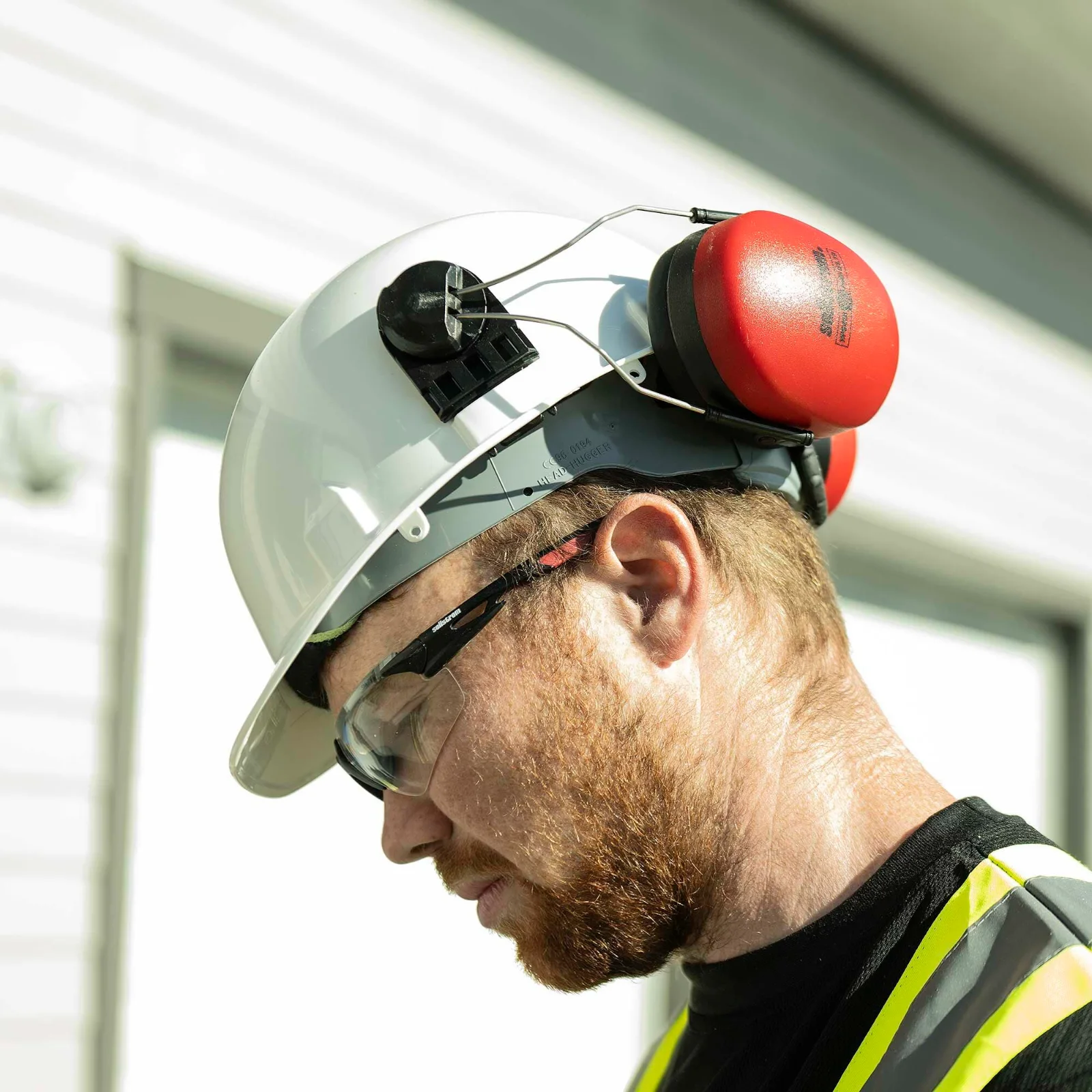
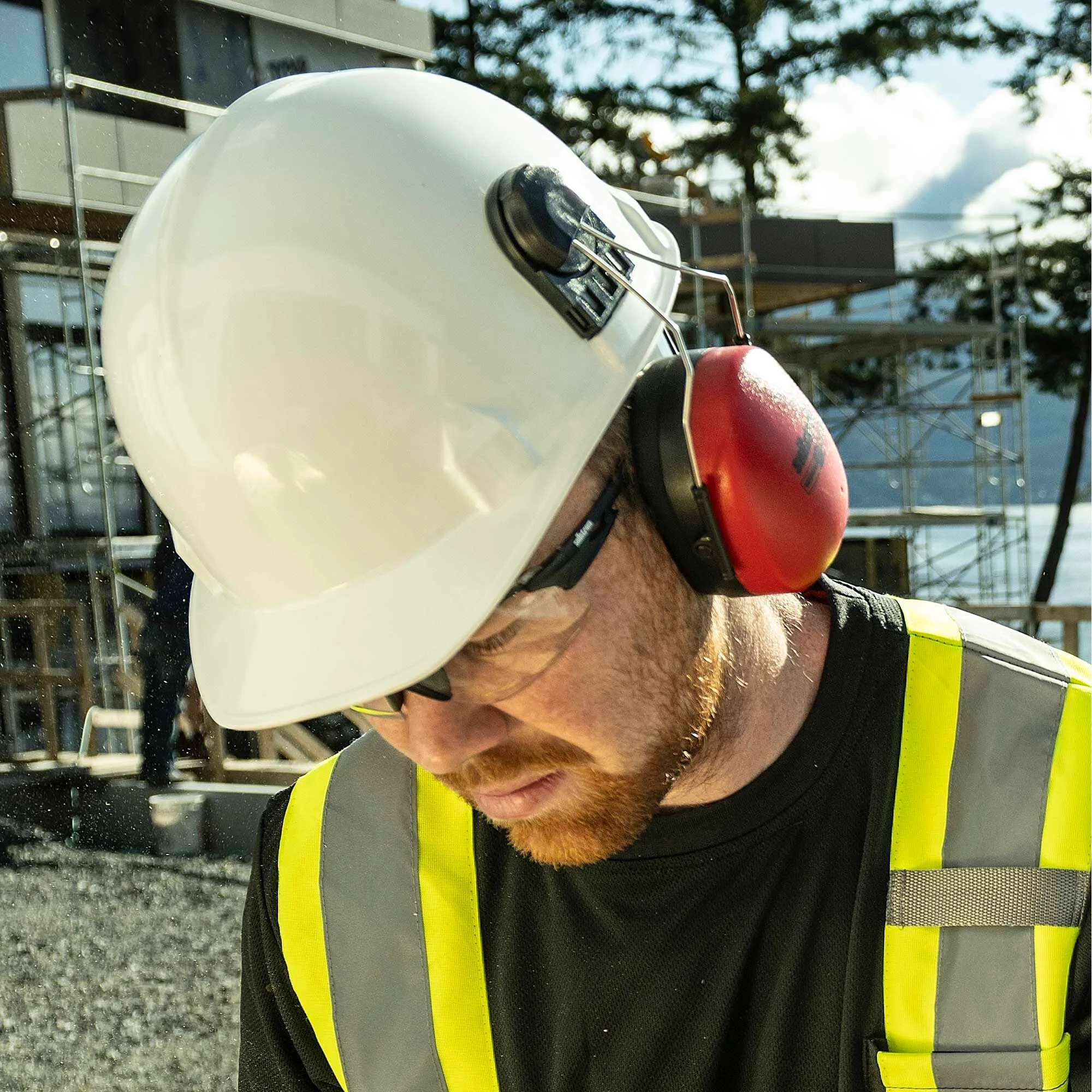
The Sellstrom Adjustable Safety Ear Muffs, 25 dB carry an NRR of 25 under ANSI S3.19 and CSA Class A. They have soft blue cups, adjustable tension bands for positioning and dielectric insulation. For hard hat crews, our hearing protection shelf also holds cap mounted muffs that clip into hard hat slots.
When OSHA's rules start: 85 dBA and table G-16
NIOSH counts about 27 million workers exposed to hazardous noise at work each year. About 1 in 9 people in the US working population has hearing difficulty, and about 1 in 13 has tinnitus. NIOSH warns that repeated exposures to sounds of 85 dBA or higher can cause permanent hearing loss, and its recommended limit is 85 dBA averaged over an eight hour day.
OSHA's noise standard, 1910.95, starts its hearing conservation program at the same level. Whenever exposure equals or exceeds an 8 hour time weighted average of 85 dBA, the employer runs the program and makes hearing protectors available to everyone exposed at no cost. Employees get to choose from a variety of suitable protectors. That choice matters more than it sounds, because a protector you will actually wear correctly beats a higher number you pull out after an hour. Above the limits of table G-16, OSHA requires feasible administrative or engineering controls first.
| Hours per day | Sound level, dBA (slow response) |
|---|---|
| 8 | 90 |
| 6 | 92 |
| 4 | 95 |
| 3 | 97 |
| 2 | 100 |
| 1.5 | 102 |
| 1 | 105 |
| 0.5 | 110 |
| 0.25 or less | 115 |
Read the table as a trade. Every 5 dBA added halves the time allowed, so a tool that runs at 100 dBA uses up a full day's allowance in 2 hours.
Turning the NRR into a number for your shop
OSHA's Appendix B to 1910.95 gives the arithmetic, and paragraph (j)(1) of the standard asks the employer to evaluate attenuation for the specific noise where the protector is used. When the noise is measured in dBA, the steps are short.
- Take the NRR from the box and subtract 7 dB.
- Subtract what is left from the A weighted time weighted average.
- The result is the estimated A weighted exposure under the protector.
Worked through with our own two ratings at 100 dBA: the foam plug at NRR 32 gives 32 minus 7, or 25, so the estimate under the plug is 75 dBA. The muff at NRR 25 gives 18, and an estimate of 82 dBA. When a meter reads in dBC instead, Appendix B skips the 7 and subtracts the full NRR from the C weighted level.
OSHA attaches a warning to both methods. Calculated attenuation values reflect realistic values only to the extent that the protectors are properly fitted and worn. Put that next to NIOSH's finding that most workers get less than half of the label, and the 75 on paper is the best case, not the forecast. The standard sets the floors for the result. Protectors must bring exposure down to at least an 8 hour average of 90 dBA, and to 85 dBA or below for a worker who has already shown a standard threshold shift.
Plugs and muffs together at 100 dBA
Some work runs past what one protector should be asked to handle. NIOSH recommends double hearing protection, earmuffs over earplugs, for workers exposed to 100 dBA or greater or to impulse sounds. At 100 dBA, table G-16 allows 2 hours. Where your measurement reads that high, or the noise comes in sharp bangs, both go on.
Two ratings on two boxes are not a sum, so do not add 32 and 25. Fit each device as if it were working alone. Seat the plugs fully, then close the muff cushions over them without pressing a cord or a hood under the seal. Our Adjustable Safety Ear Muffs are suggested for pairing with the Sellstrom Foam Ear Plugs, 32 dB for exactly this kind of high exposure.
Choosing what goes on your ears
- Know your number first. A noise measurement in dBA tells you which row of table G-16 you live in and whether you are past 85.
- Treat the NRR as a ranking, not a promise. Use the Appendix B method to estimate, and plan for less.
- Lean toward plugs when glasses or long hair break a muff seal, and toward muffs when protection comes on and off all day.
- Go double at 100 dBA and for impulse noise.
- Ask about fit testing. A PAR is the only number that belongs to you.
If you also wear eye protection with your muffs, our eye and face protection guide covers frames and goggles, and our safety glasses shelf lists the frames we make.
