


A grinding wheel throws a chip faster than your hand can come up. NIOSH counts about 2000 U.S. workers a day with a job-related eye injury that needs medical treatment, and it says most of them come from small particles or objects striking or scraping the eye: dust, cement chips, metal slivers and wood chips. Those are exactly the things that slip under the lower edge of a face shield, or come in from the side when you turn your head toward a noise.
That is why the shield is the second layer, never the only one. Once both layers are on, two choices are left to you: the window you look through, and whether the shield rides on a hard hat or on its own ratchet headgear.
What a face shield is built to stop
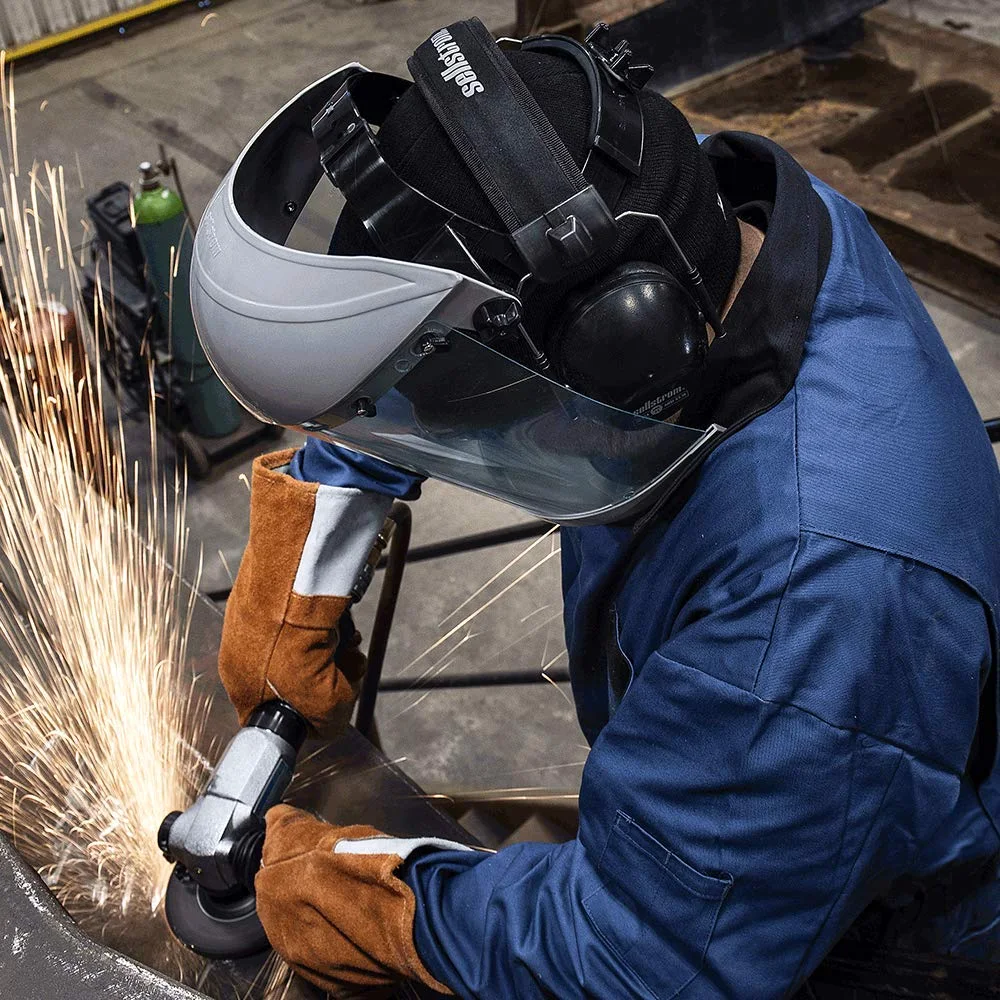
OSHA describes face shields in its personal protective equipment guide, Publication 3151, as transparent sheets of plastic that run from the eyebrows to below the chin and across the full width of the head. The same guide is blunt about the limit. Face shields protect against splashes or sprays of hazardous liquids, droplets and particles "but will not provide adequate protection against impact hazards." The next sentence gives the fix: a face shield worn in combination with goggles or safety spectacles provides additional protection against splash and impact hazards.
So the order is fixed. Your safety glasses or goggles go on first and do the impact work. The shield goes over them and catches the spray, the sparks off the wheel and the drip of solvent that would otherwise reach your cheeks, lips and neck. Take either layer away and you leave a gap somewhere on your face.
Glasses or goggles under the shield
OSHA's eye and face rule, 29 CFR 1910.133, asks for eye protection with side protection whenever there is a hazard from flying objects. NIOSH adds that Z87.1 requires wraparound coverage or side shields on safety glasses for impact protection, and that eyewear rated for high impact is marked Z87+. Prevent Blindness puts the floor in one sentence: around particles, flying objects or dust you must at least wear safety glasses with side shields. Working with chemicals, it says, you should wear goggles.
- Grinding, chipping and wire brushing: safety glasses with side protection, shield over them.
- Pouring, mixing or spraying chemicals: goggles that seal to the face, shield over them.
- Prescription lenses: 1910.133 accepts eye protection with the prescription built in, or protection worn over your glasses without pushing either pair out of position. The Sellstrom Odyssey II Safety Goggle has an OTG design that fits over most prescription eyeglasses.
Fog is the usual reason people pull the glasses off and keep only the shield. Treat fog as a fit problem, not as a reason to drop a layer. An anti-fog lens under an anti-fog window, with the crown set high enough that air can move between them, gives the moisture somewhere to go.
Clear, anti-fog or acetate: picking the window
The window is the part you look through all shift, and it wears out long before the crown does. Three questions decide it. What hits it, what splashes on it, and how warm does your face get behind it?
Polycarbonate is the default where impact is part of the job. The American Academy of Ophthalmology recommends polycarbonate for protective eyewear because it resists shattering. The Sellstrom DP4 Multi-Purpose Anti-Fog Window is clear polycarbonate with an anti-fog coating, 12.125 by 9 inches and 0.060 inch thick, and it carries the ANSI Z87+ and CSA Z94.3 marks when it is assembled on a DP4 series face shield. That condition matters more than it looks. A window is rated together with the crown it was made for, so a DP4 window belongs on a DP4 crown.
Acetate is the other clear option. The Sellstrom 380 Series Replacement Window is clear acetate with the Sta-Clear anti-fog coating, made for chemical splash and scratch resistance. It measures 19.5 by 6.5 inches at 0.040 inch, a wider and thinner sheet than the DP4 window, and it fits the 380 series crowns. Pick acetate where solvent spray and constant wiping wear a window down faster than flying chips do.
Uncoated windows still have a place. The Sellstrom 301 Series V-Shaped Window is clear uncoated polycarbonate, 15 by 9 inches, with a universal hole pattern that fits the 301 crown and a range of other crowns. In a cool, dry shop where fog never builds, an uncoated window is simply one less surface to wear.
Shade IR windows are for the torch, not the arc
A tinted IR window looks like welding protection, and that look is where people get hurt. OSHA's shade table in 1910.133 sets the minimum shade by process. Torch soldering needs Shade 2 and torch brazing Shade 3. Oxygen cutting needs Shade 3 for light work under one inch, Shade 4 from one to six inches and Shade 5 for heavy cutting over six inches. Gas welding runs from Shade 4 on metal under 1/8 inch to Shade 6 on metal over 1/2 inch.
Arc welding starts much higher. The same table puts shielded metal arc welding under 60 amps at Shade 7 and climbs to 11, and OSHA's welding rule, 1910.252, requires helmets or hand shields during all arc welding and arc cutting except submerged arc welding. A Shade 3 or Shade 5 window has no place in front of a MIG or stick arc. For the arc, read the welding shade guide and wear a helmet.
For torch work the windows map cleanly onto the table. The Sellstrom DP4 Replacement Window, Shade 3 IR is anti-fog polycarbonate cut for the DP4 crown, at the minimum OSHA lists for torch brazing. The Sellstrom DP4 Face Shield with Flip-Up IR Visor keeps a clear window in place and adds a spring-mounted flip-up visor offered in Shade 5, 6 and 8 IR and a Shade 6 cobalt tint. You grind with the visor up and drop it for the cut. OSHA's footnote applies here too: start with a shade too dark to see the work, then go lighter until you see it well, without going below the minimum.
| Window | What it is | Work it suits |
|---|---|---|
| Sellstrom DP4 Multi-Purpose Anti-Fog Window | Clear polycarbonate, anti-fog, 12.125 x 9 x 0.060 in | Grinding, cutting and splash, worn over glasses or goggles |
| Sellstrom 380 Series Replacement Window | Clear acetate, Sta-Clear anti-fog, 19.5 x 6.5 x 0.040 in | Chemical splash and work where the window is wiped often |
| Sellstrom 301 Series V-Shaped Window | Clear uncoated polycarbonate, 15 x 9 x 0.060 in | Dry impact work on the 301 and other crowns |
| Sellstrom DP4 Replacement Window, Shade 3 IR | Shade 3 IR polycarbonate, anti-fog | Torch brazing (OSHA minimum 3), light oxygen cutting (3) |
| Shade 5 IR flip-up visor | Spring-mounted over a clear window | Heavy oxygen cutting (5), medium gas welding (5) |
| Sellstrom Arc Flash Replacement Window | Green tint polycarbonate, 9.9 cal/cm², 8 x 15 in | Electrical arc flash work, never welding |

When to replace a window
A window rarely fails all at once. It scratches, pits from sparks and hazes as the coating wears, until one day you catch yourself tilting your head to see around a blur. That tilt is the signal. Change the window when any of these is true:
- Scratches or spark pits sit in your line of sight and you lean or squint to look past them.
- The anti-fog coating has worn through and the window fogs where it used to stay clear.
- Solvent has clouded, softened or crazed the surface.
- The window took a hard hit, even if you see no crack.
- It no longer seats firmly on the crown, or the mounting holes have torn.
Before you order, read the marks on the old one. OSHA's 1910.133 requires eye and face protection to be distinctly marked to identify the maker, and NIOSH notes that industrial face shields are marked Z87 for normal wear and Z87+ for high impact. Match the replacement to the crown series, a 380 window to a 380 crown and a DP4 window to a DP4 crown, and peel the protective film off both sides before the first use. The replacement window shelf groups them by series.
Hard hat mount or ratchet headgear
The crown has to sit on something. On a site where a hard hat stays on all day, a shield that mounts to the hat spares you a second band around your head. The Sellstrom Single Crown Hard Hat Face Shield comes with universal slot adapters that fit most slotted hard hats, a clear anti-fog polycarbonate window and a spring-mounted Shade 5 IR flip front for oxy/acetylene cutting, brazing and plasma or flame cutting. The hard hat itself is not included. The Sellstrom Premium Dual Crown Hard Hat Face Shield adds a chin protector and uses the S61970 universal slot adapter.
In a shop without a hard hat rule, ratchet headgear is simpler. The Sellstrom DP4 Face Shield sits on ratchet suspension with a twist knob that sets height and fit, comes fully assembled, and offers clear, Shade 3 IR and Shade 5 IR windows. When the band stretches or the ratchet starts to slip, the Sellstrom DP4 Replacement Ratchet Headgear swaps in with positive lock adjustment, and the rest of the shield stays in service.
Either way, the test is the same. With your glasses or goggles on, set the shield so the window clears them without pressing the frame into your nose, and so its lower edge reaches below your chin. OSHA asks that protection worn over prescription lenses not disturb their position, and the same logic holds for plain safety glasses. A shield that knocks your glasses out of place opens a gap at the very spot you meant to cover.
A fitting routine for the start of a shift
- Glasses or goggles on first, with side protection wherever particles fly.
- Shield on, crown set high enough that the window clears your lenses.
- Window chosen for the work: clear for grinding and splash, Shade IR only for the torch.
- One look through the window at the job before you start. If you lean to see, swap the window.
We have made eye and face protection since 1923, and the about Sellstrom page tells that story. The eye and face protection guide walks through each hazard in turn, and the face shields shelf lists every crown, window and headgear we make. AAO says plainly that safety glasses are not foolproof. That is the whole case for wearing two layers instead of one.
