

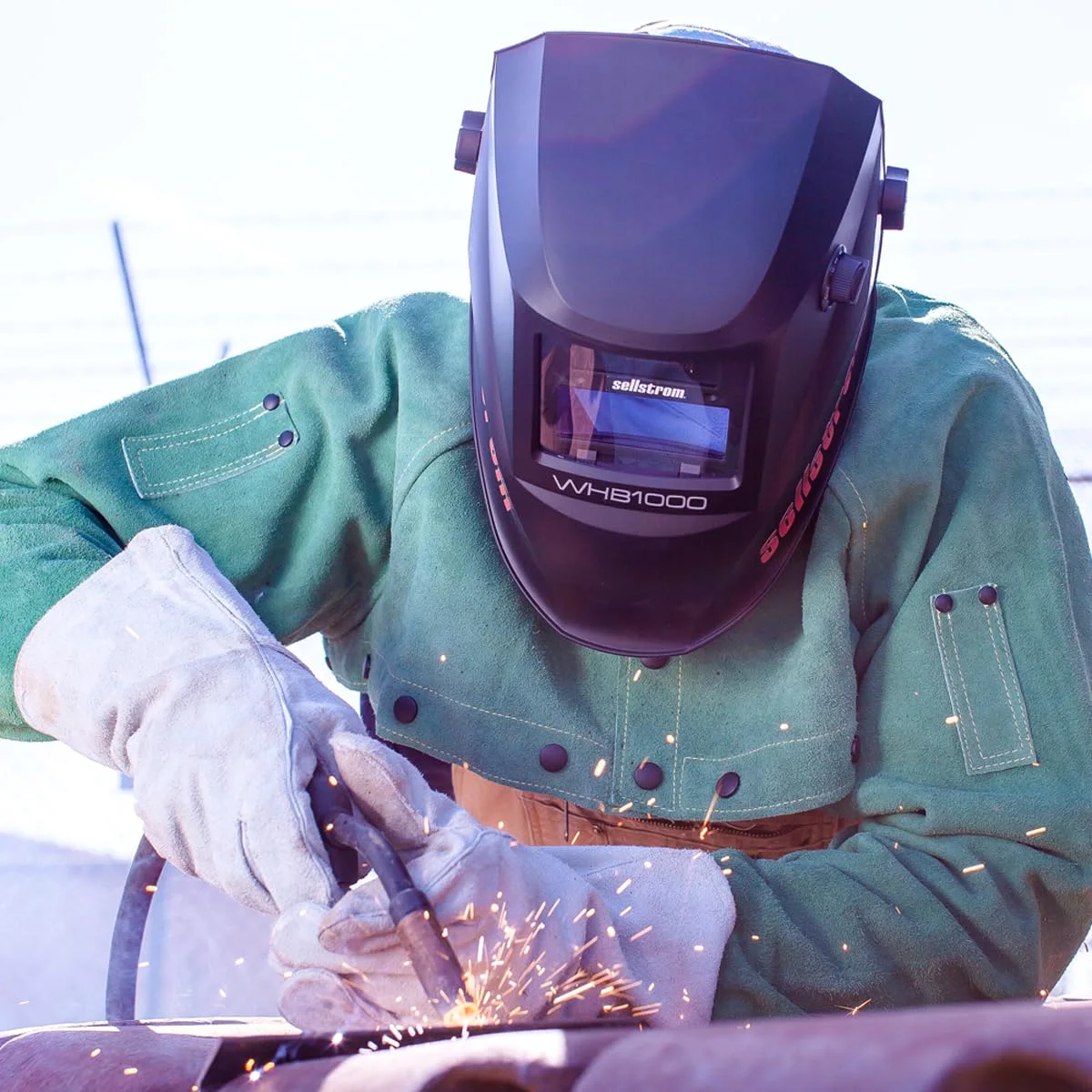
NIOSH lists thermal burns to the eye among the injuries it sees, and it says they happen often among welders. The arc gives off ultraviolet and infrared light that you cannot feel until the damage is done, plus sparks, spatter and slag that you can. A welding helmet answers all of that at once, and the first real choice you make is how its dark lens behaves.
There are two answers. A passive helmet carries a filter plate with one fixed shade. An auto-darkening helmet carries an electronic filter that stays light until the arc strikes, then switches to a dark shade you have set. Both can do the job. They suit different welders, different work and different habits.
What OSHA asks of any welding helmet
OSHA's welding rule, 29 CFR 1910.252, requires helmets or hand shields during all arc welding and arc cutting, except submerged arc welding. Helmets must be made of a material that insulates against heat and electricity, and they must protect the face, neck and ears from direct radiant energy from the arc. They must not be readily flammable, and the lenses must bear a permanent mark that shows their source and shade.
OSHA's guide to personal protective equipment, Publication 3151, describes what that buys you. Welding shields protect the eyes from burns caused by infrared or intense radiant light, and they protect the eyes and face from flying sparks, metal spatter and slag chips. Nothing in either document prefers a passive lens over an auto-darkening one. What the rules care about is the shade in front of your eyes when the arc is lit.
Passive helmets: one plate, lift front or fixed front
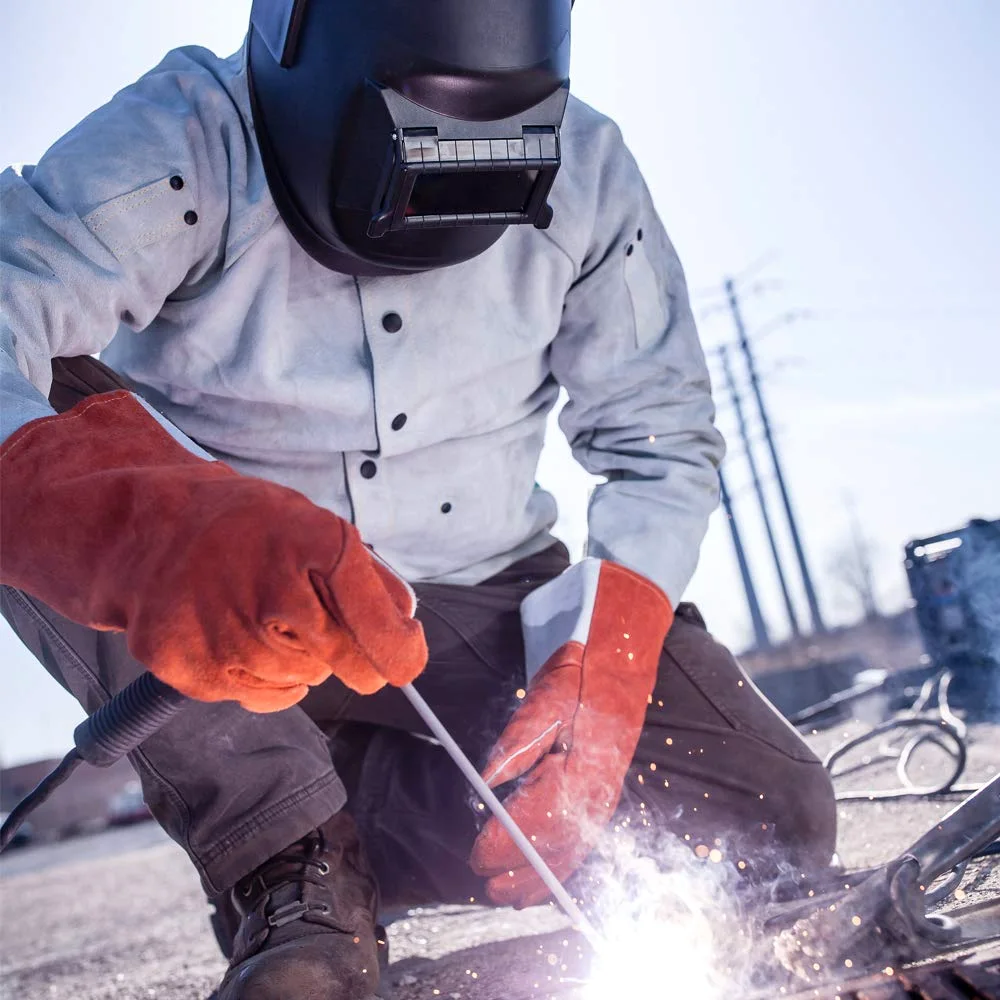
A passive helmet is a shell, a clear cover plate and a filter plate of one shade. Through a Shade 10 plate you see almost nothing until the arc lights, so you set the gun or rod in position, then nod the helmet down. It has no battery and no sensor, so nothing in the lens can switch late or quit halfway through a bead.
Passive helmets come in two shapes. On a lift front, the filter sits in a hinged frame you can raise. The Sellstrom 293 Lift Front Welding Helmet has a 2 by 4-1/4 inch lift front with a spring-loaded positive lock, the Sel-Snap system for loading filter and cover plates, and a rigid neck bib against spatter and IR heat. Raise the front and the dark plate leaves your line of sight, so you can set up the next joint without taking the helmet off.
A fixed front has no hinge and usually a larger window. The Sellstrom Super Tuff Fixed Front Welding Helmet, Silver carries a Sel-Snap fixed front, and you lift the whole helmet between welds. Larger fixed fronts take the 4-1/2 by 5-1/4 inch plate, such as the Sellstrom Gold Coated Filter Plate, Shade 11. Its gold coating adds heat and light reflection for intense welding operations.
Auto-darkening helmets: sensors and a shade range
An auto-darkening filter reads the arc through sensors and darkens in the moment it strikes. You keep the helmet down from setup through the bead, which suits welders who tack all day or work out of position. The cost is a lens that depends on sensors and power, so it needs a little care.
The Sellstrom Auto-Darkening Welding Helmet comes in three styles. The Advantage has external controls, a 2 by 4 inch viewing area, a variable shade of 4 and 9 to 13, a grind mode and two independent sensors. The Advantage+ moves the controls inside, adds sensitivity and delay adjustments and uses four sensors. The Premium widens the view to 3.5 by 4 inches, keeps four sensors, adds three memory settings and uses blue lens technology that reduces sodium glow from the weld.
Read that shade range against your work. Shade 4 is the light state and the grind setting. The dark range starts at 9 and tops out at 13, which covers most arc work in OSHA's table but stops one step short of the Shade 14 it lists for carbon arc welding. Torch brazing and oxygen cutting sit far below 9, so for the torch you want goggles or a face shield with a Shade IR window instead.
Sensors only work when they can see the arc. Spatter on the cover plate, a glove in the way or an odd angle can leave a sensor blind. That is why the Sellstrom WHP4000 Replacement Auto-Darkening Filter has four independent sensors placed to reduce the chance of blockage, and why it runs on battery and solar power.
Reading OSHA's shade table for your process and current
OSHA's eye and face rule, 1910.133, holds a table of minimum protective shades. Find your process, find the current you run, and read across. The number is a floor, not a target. The footnote tells you how to use it: start with a shade that is too dark to see the weld zone, then go to a lighter shade that gives enough of a view without going below the minimum.
| Process | Electrode size or arc current | Minimum shade |
|---|---|---|
| Shielded metal arc (stick) | Under 3/32 in, under 60 A | 7 |
| Shielded metal arc (stick) | 3/32 to 5/32 in, 60 to 160 A | 8 |
| Shielded metal arc (stick) | 5/32 to 8/32 in, 160 to 250 A | 10 |
| Shielded metal arc (stick) | Over 8/32 in, 250 to 550 A | 11 |
| Gas metal arc and flux cored | Under 60 A | 7 |
| Gas metal arc and flux cored | 60 to 500 A | 10 |
| Gas tungsten arc (TIG) | Under 50 A and 50 to 150 A | 8 |
| Gas tungsten arc (TIG) | 150 to 500 A | 10 |
| Air carbon arc cutting | Light, under 500 A | 10 |
| Air carbon arc cutting | Heavy, 500 to 1000 A | 11 |
| Plasma arc cutting | Light, under 300 A | 8 |
| Plasma arc cutting | Medium 300 to 400 A, heavy 400 to 800 A | 9, 10 |
| Torch brazing | Any | 3 |
| Carbon arc welding | Any | 14 |
Take a few common jobs. MIG at 120 amps falls in the 60 to 500 amp band for gas metal arc, so the minimum is 10, and a Shade 9 plate sits below it. Stick welding with a 1/8 inch rod at around 100 amps lands in the 3/32 to 5/32 inch row, minimum Shade 8. TIG at 150 amps or less needs Shade 8, and from 150 amps up it needs 10. Our welding shade guide carries the full table, including gas welding and oxygen cutting.
For a passive helmet, that reading decides which plate you buy. The Sellstrom Polycarbonate Filter Plate, 2 x 4-1/4 in comes in Shade 6, 9 and 10 IR. Shade 10 meets the MIG minimum across the table. Shade 9 serves medium plasma cutting and stick work in the 60 to 160 amp row for welders who want a little more light than a 10. For heavy stick work over 250 amps, step up to an 11.
Cover plates and the two plate sizes
The filter plate is not the first thing the spatter hits. A clear cover plate sits in front of it and takes the pitting, and it is the part you expect to throw away. The Sellstrom CR-39 Cover Plate protects against pitting and scratching and comes in both sizes. On auto-darkening helmets the filter sits between two cover plates, and the Sellstrom WHP4000 Replacement Cover Plates come as a set of 5 outer and 5 inner plates.
Two plate sizes cover most helmets, and the size has to match the opening:
- 2 x 4-1/4 in: lift fronts such as the 293 helmet, the Sellstrom Iron Mask Hand Shield, Shade 10, and the Sellstrom Welding Helmet Flip Front Adapter, which takes a passive plate or a drop-in auto-darkening filter of that size.
- 4-1/2 x 5-1/4 in: larger fixed front windows, and plates such as the Sellstrom Gold Coated Filter Plate, Shade 11.
Measure the opening or read the size off the old plate before you order. Change the cover plate as soon as spatter pits sit in your line of sight, because a pitted cover makes you lean in toward the arc. If you need reading glasses to see the puddle, the Sellstrom Magnifier Plate sits behind passive and auto-darkening filters in the 2 x 4-1/4 inch size, in diopters from 0.75 to 3.00. The welding lens shelf holds the filter, cover and magnifier plates together.
Safety glasses go under the helmet
Plenty of the hazards in a welding shop arrive with the helmet up. You chip slag, run a wire brush over the bead, grind a tack flat or walk past someone else's work, and none of that waits for the helmet to come down. NIOSH says most eye injuries come from small particles striking or scraping the eye, and slag chips and metal slivers are exactly that.
So wear safety glasses under the helmet, every time. OSHA's 1910.133 asks for side protection wherever objects fly, and NIOSH notes that Z87.1 requires wraparound coverage or side shields on safety glasses for impact protection. The American Academy of Ophthalmology puts welding in its own class: it requires more eye and face protection than ordinary work. If you wear a prescription, 1910.133 lets you use protection with the prescription built in or protection that fits over your glasses without moving them. The safety glasses shelf has both kinds.
Passive or auto-darkening: a short decision list
- You strike many short arcs an hour, tack, or weld out of position: auto-darkening saves the nod and keeps the helmet down through setup.
- You run long beads at one current and want nothing that needs a battery: a passive helmet with the right plate does the job.
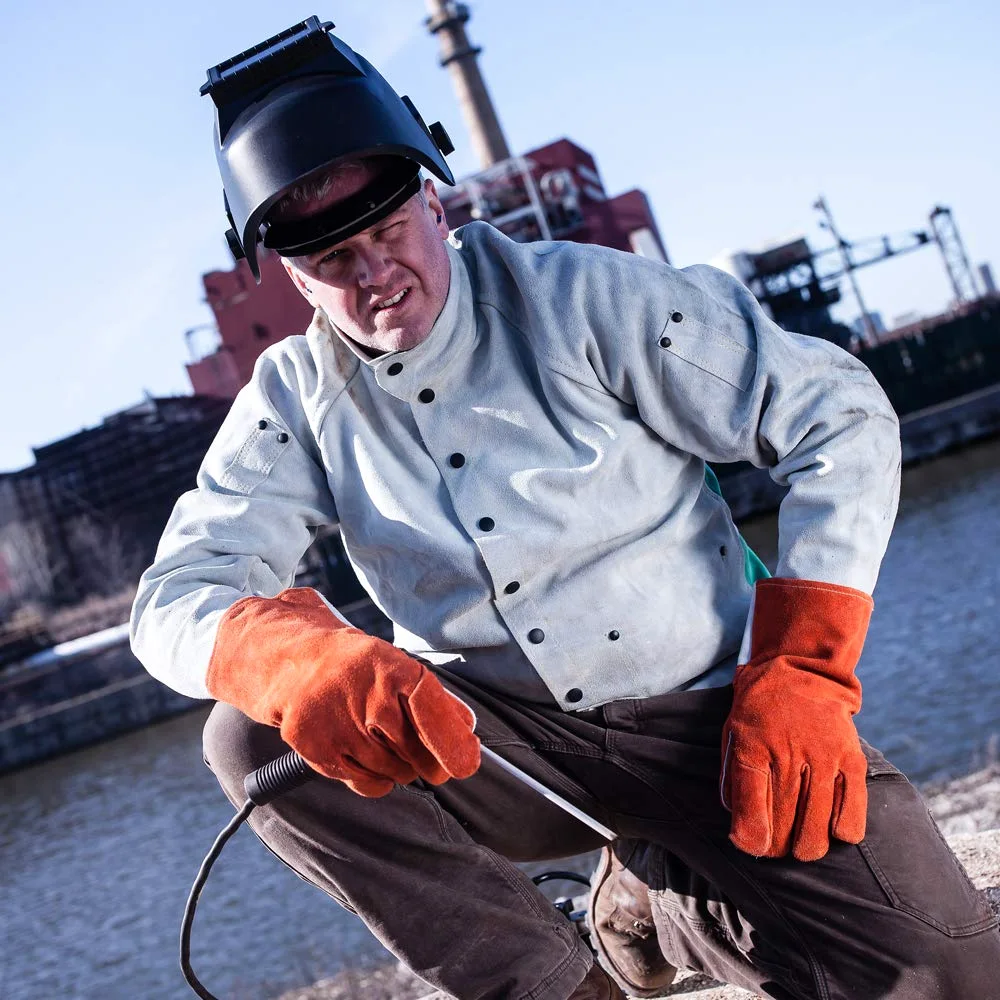
- You switch between welding and grinding: an auto-darkening helmet with a grind mode, or a lift front you can raise, plus glasses underneath either way.
- You weld carbon arc at Shade 14: a passive plate of that shade, since this auto-darkening range stops at 13.
- You do torch brazing or oxygen cutting: neither helmet, but goggles or a face shield with a Shade IR window.
Whichever helmet you choose, the shade comes from the table and the glasses come first. Every helmet we make sits on the welding helmets shelf, and the eye and face protection guide covers the other hazards in a welding bay.
